We get this question every day: Why Do Houses Burn in Wildfires?
When people think about wildfire protection, they often focus on one central question: Are the walls fireproof? It sounds logical. If a house is built with concrete, brick, or another non-combustible material, many assume it has a strong chance of surviving a fire.
According to our APIRA’s wildfire protection philosophy, this assumption can create a false sense of security.
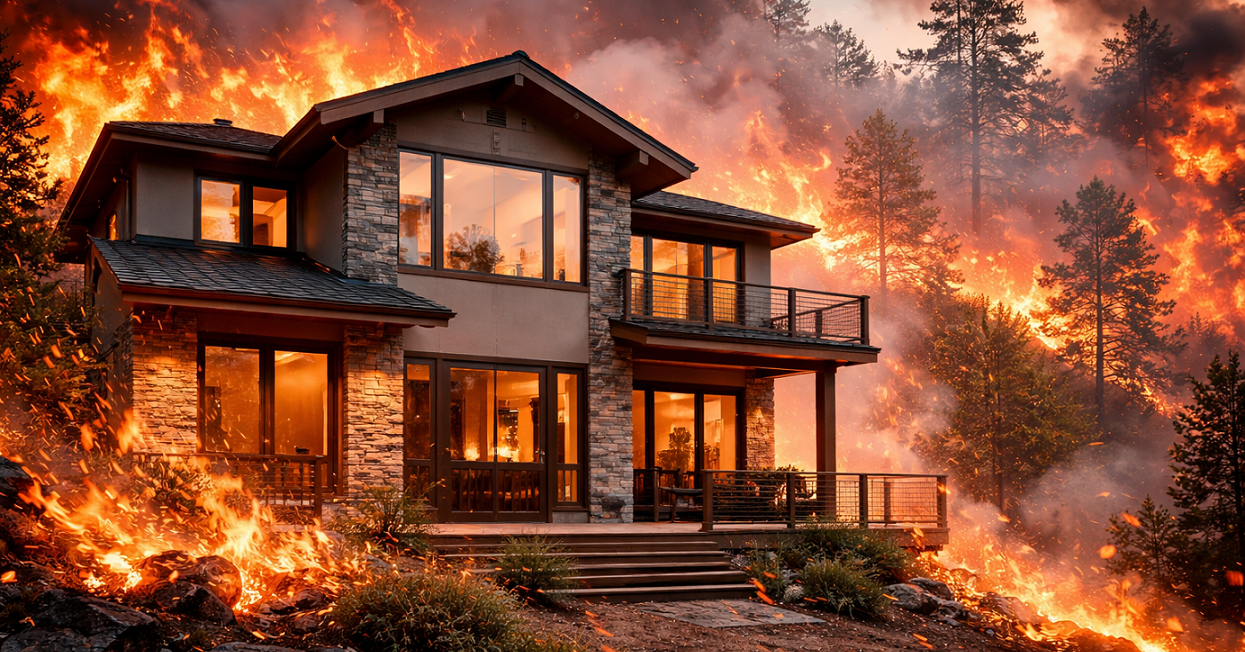
In many wildfire events, the main reason a house is lost is not that the exterior walls themselves caught fire first. The greater danger often comes from ember intrusion and extreme radiant heat reaching the building’s vulnerable points. Once fire enters through an opening, the interior can ignite, and the structure may then be destroyed from the inside out.
This is a critical distinction. It changes the way we should think about wildfire safety, building vulnerability, and real protection.
The Main Reason Houses Burn Is Often Ember Intrusion
One of the most underestimated wildfire threats is the ember. Embers, also called firebrands, are small burning particles carried by the wind, often far ahead of the main wildfire front. In severe fire conditions, they can travel long distances and land on or around homes that may appear to be outside the immediate fire line.
This means a house does not need to be directly touched by flames in order to be at risk.
Embers can gather in hidden or exposed areas of the structure. They may enter through attic vents, chimneys, gaps, cracks, roof edges, or any vulnerable opening in the building envelope. Once inside, they can remain active, smolder quietly, and ignite combustible materials later.
This delayed ignition is one of the reasons wildfire damage can be so deceptive. A home may look untouched at first, yet hidden ignition may already be developing inside.
Radiant Heat Is Another Serious Threat
The second major factor in house loss during wildfires is radiant heat.
Radiant heat does not need direct flame contact to cause severe damage. When nearby vegetation, vehicles, neighboring structures, or other combustible elements are burning, the heat they produce can become intense enough to affect a house even before flames physically arrive.
This extreme heat can:
- crack or shatter windows
- weaken frames
- deform or melt doors and protective components
- create new entry points for embers and flames
- raise interior materials to ignition temperature
In practical terms, this means that a home can become exposed to fire because the heat compromises its weak points first. Once those barriers fail, the fire gains access to the inside.
The Weak Points of a House Are Rarely the Walls
After a series of APIRA’s experiments, our viewpoint highlights an important truth: the most vulnerable areas of a house are usually not the solid walls.
The real weak points are typically:
- windows
- doors
- vents
- roofs
- eaves
- edge details and openings in the building envelope
These are the areas where embers can enter and where radiant heat can cause failure. Even a house made of highly resistant materials can still be destroyed if these touchpoints are left exposed.
This is why looking only at the wall material is not enough. A concrete or brick wall may remain standing, but the home can still suffer catastrophic loss if fire enters through a window, a roof detail, a vent, or another opening.
Why Fire-Resistant Walls Alone Are Not Enough
A common mistake in wildfire protection is focusing too narrowly on a wall’s fire rating. Of course, non-combustible walls are valuable. They play an important role in overall building resilience. But they do not solve the whole problem.
APIRA’s approach makes this clear: a house is often lost because of the weakest link, not because the strongest material failed.
A brick or concrete house does not usually burn because embers pass through the wall itself. Embers do not typically burn through solid masonry. Instead, they find a way through the openings in the building envelope. Once inside, they can ignite furniture, curtains, paper, insulation, wood elements, and other combustible contents. From there, the fire can spread internally, destroying the roof structure and the rest of the home.
This is why wildfire protection must be viewed as a complete envelope problem, not simply a wall-material problem.
The Real Issue: Protecting the Building Envelope
The term building envelope refers to the outer shell of the home that separates the interior from the outside environment. In wildfire conditions, this envelope must do more than provide comfort or insulation. It must resist ember entry and protect against extreme heat.
From APIRA’s tech perspective, true wildfire protection starts with identifying and shielding every vulnerable touchpoint. That includes the openings and transition areas where fire is most likely to gain access.
If those points are not properly protected, even a robust structure can remain exposed. If they are protected effectively, the chances of preventing initial ignition increase significantly. This is the foundation of APIRA’s wildfire protection philosophy.
APIRA: Prevention Must Happen Before the Fire Enters
Wildfire protection is often discussed in terms of reaction. What happens when the flames arrive? What can firefighters do? What can homeowners do at the last minute?
APIRA’s approach is different. It is based on the idea that the most effective protection begins before the fire reaches the structure.
Rather than relying solely on emergency action during a wildfire, APIRA focuses on pre-installed, proactive protection. The goal is to reduce the risk of ember intrusion and radiant heat infiltration before these threats can enter the building.
This approach reflects a shift in thinking: from reacting to visible flames to preventing the fire from crossing the building envelope in the first place.
APIRA’s Solution: A Defensive Envelope for the Home
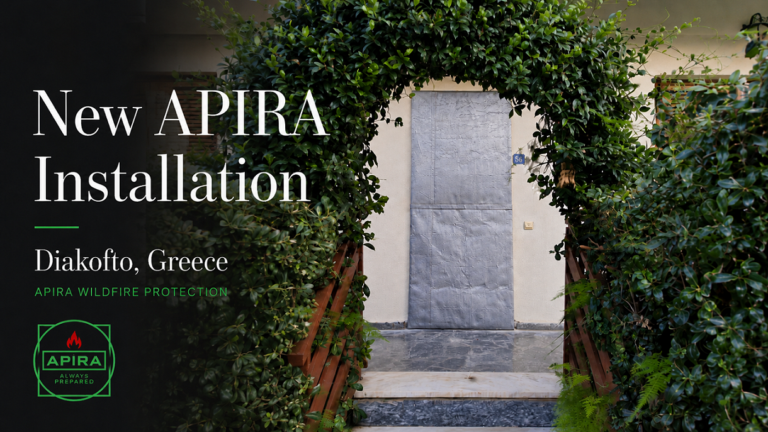
To address this challenge, APIRA offers a pre-installed wildfire protection system designed to create a defensive envelope around the vulnerable parts of the structure.
The system is built to shield critical openings such as:
- windows
- doors
- roof-related vulnerable points
- other exposed areas where embers or radiant heat may penetrate
This protective barrier is based on specialized fire-resistant fabric engineered to withstand temperatures exceeding 1,000°C.
The purpose of this system is not simply to cover a surface. Its role is to help seal the vulnerable points of the house against the two major wildfire threats identified by APIRA’s philosophy:
- ember entry
- radiant heat infiltration
By protecting these exposed touchpoints, the system aims to stop the initial pathway through which fire enters the structure.
Why This Matters for Homeowners, Developers, and Professionals
This way of understanding wildfire risk matters not only to homeowners but also to architects, engineers, developers, civil protection professionals, and anyone involved in building resilience. If the discussion remains limited to whether a wall is non-combustible, it overlooks how many homes are actually lost in wildfire events.
A more realistic wildfire protection strategy asks better questions:
- Where can embers enter?
- Which openings are exposed?
- What happens if radiant heat breaks the glass?
- How is the building envelope defended as a whole?
- Which weak points remain vulnerable even in a well-built house?
These are the questions that lead to stronger protection decisions.
Wildfire Protection Requires a Smarter Perspective
The lesson is simple but powerful. A house does not need to have combustible exterior walls to be destroyed in a wildfire. Even strong, non-combustible construction can fail if embers and heat penetrate its openings.
That is why the protection strategy must go beyond the wall. According to APIRA’s wildfire protection philosophy, the priority should be to defend the vulnerable points where fire actually enters: the windows, doors, vents, roofs, eaves, and other exposed elements of the building envelope.
Because in a wildfire, survival is often decided not by the strongest part of the house, but by the point where the structure is easiest to breach.
FAQ: How Houses Burn in Wildfires
How do houses usually burn in wildfires?
Houses often burn because embers and extreme radiant heat enter through vulnerable openings such as windows, doors, vents, roofs, and eaves. The fire then ignites the interior or hidden combustible materials.
Are exterior walls the main reason a house burns in a wildfire?
Not usually. APIRA’s viewpoint is that walls are often not the primary problem. Even if walls are made from non-combustible materials like brick or concrete, a house can still be destroyed if embers or heat enter through openings in the building envelope.
What is ember intrusion in a wildfire?
Ember intrusion happens when wind-blown burning particles enter a house through vulnerable points such as attic vents, chimneys, cracks, roof edges, or damaged windows and doors. These embers can ignite materials inside the house.
Why is radiant heat dangerous during a wildfire?
Radiant heat can break windows, deform doors, and weaken other protective parts of a home without direct flame contact. Once those weak points fail, embers and fire can enter the structure.
What are the weakest points of a house during a wildfire?
The most vulnerable areas are usually windows, doors, vents, roofs, eaves, and other exposed openings. These points are more likely to allow ember entry or fail under extreme heat.
Can a concrete or brick house still burn in a wildfire?
Yes. A house with non-combustible walls can still burn if embers or radiant heat enter through openings and ignite the interior contents or roof structure.
What does APIRA mean by a defensive envelope?
APIRA uses the term to describe a proactive protective barrier around a structure’s vulnerable points. The goal is to prevent embers and radiant heat from entering through windows, doors, roofs, and other exposed touchpoints.
What is APIRA’s wildfire protection solution?
APIRA offers a pre-installed protection system that uses specialized fire-resistant fabric to shield vulnerable openings and withstand temperatures above 1,000°C. The purpose is to reduce the risk of ember intrusion and radiant heat infiltration.
Why is pre-installed wildfire protection important?
Wildfire protection is more effective when it is already in place before the fire arrives. Pre-installed systems help defend the building envelope without depending only on last-minute emergency action.
What should homeowners focus on for better wildfire protection?
Homeowners should focus on protecting the full building envelope, especially the vulnerable openings where embers and heat are most likely to enter. Effective wildfire protection must address the structure’s weakest links, not only the wall materials.
📞 Request Your Personalized Risk Assessment
Every property is different. Terrain, vegetation, orientation, materials, and exposure levels all matter. The smartest next step is a personalized wildfire risk assessment.
📞 Get your free quote and tailored protection plan today.
Protect your home before the next fire season begins.